

If your dentist or orthodontist has ever mentioned a narrow palate, or you have noticed your upper jaw seems tight or crowded, it is natural to wonder what a narrow palate actually looks like compared to a normal one, and whether it is something you should look into.
To tell if you have a narrow palate, look for crowded teeth, a high or V-shaped roof of the mouth, a crossbite, frequent mouth breathing, or a tongue that feels like it does not have enough room. None of these signs confirm it on their own, but if a few sound familiar, it is worth a closer look.
A narrow palate, also called a narrow upper jaw, is exactly what it sounds like: the roof of the mouth is more constricted than average, which can affect everything from how your teeth fit to how easily you breathe through your nose.
What Is Considered a Narrow Palate?
There is no single measurement that applies to everyone, since jaw size naturally varies. What matters more than any one number is whether the palate is providing enough room for the teeth, the tongue, and normal nasal breathing. A palate that is too narrow for someone's own teeth and tongue is considered narrow for that person, even if it might be an unremarkable width on someone else.
Here is what a narrow palate can look like compared to a typical one:
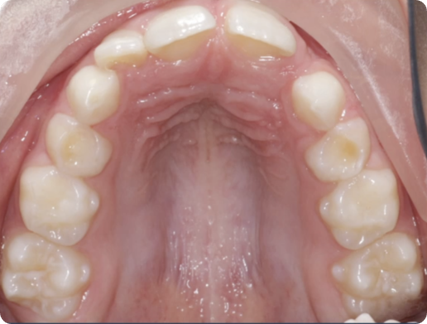
Narrow (V-shaped) palate
Less room for the tongue and teeth
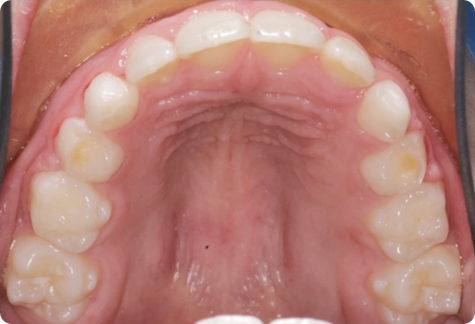
Normal (U-shaped) palate
More space for the tongue and teeth
These images capture the basic idea Dr. Stella walks patients through when explaining what a narrow palate actually looks like: a narrower, more V-shaped arch leaves less room for the tongue and teeth, while a broader, U-shaped arch generally leaves more.
| Narrow palate | Normal palate | |
|---|---|---|
| Shape | High, V-shaped roof of the mouth | Broader, U-shaped roof of the mouth |
| Tongue space | Limited, may feel crowded or scalloped | Adequate room for the tongue to rest and move |
| Teeth | Often crowded, may show a crossbite | More room for teeth to erupt and align naturally |
| Breathing | More prone to mouth breathing, less nasal airway volume | Better supports nasal breathing |
| Typical treatment | Expander, timing depends on age | Usually no treatment needed |
What Causes a Narrow Palate?
A narrow palate usually develops from a combination of genetics and habits during childhood. Some of the more common contributors include:
- Genetics, some people are simply born with a narrower jaw structure
- Prolonged thumb-sucking or pacifier use
- Low resting tongue posture, when the tongue does not rest against the roof of the mouth enough to help guide its width
- Chronic mouth breathing, which can both result from and contribute to a narrower palate over time
It is worth noting that mouth breathing and a narrow palate often reinforce each other, a tight airway can push someone toward mouth breathing, and mouth breathing itself can discourage the tongue posture that would otherwise help widen the palate. That cycle is part of why Dr. Stella looks at the airway and the bite together rather than treating them as separate issues.
Signs and Symptoms of a Narrow Upper Jaw
Here is how Dr. Stella describes the at-home signs worth paying attention to:
What are some at-home signs that may suggest a narrow palate? Look for crowded teeth, a high or V-shaped roof of the mouth, crossbite, frequent mouth breathing, or a tongue that feels like it does not have enough space. You may also notice a scalloped tongue, with small indentations along the sides from pressing against the teeth.
Dr. Stella
A quick self-check is not a diagnosis. These signs can point toward a narrow palate, but the only way to know for certain is a clinical evaluation.
What Does Palatal Expansion Actually Change?
Here is how Dr. Stella explains what expansion changes, in her own words:
So, what does palatal expansion actually change? Before treatment, this upper jaw is narrow and more V-shaped. After expansion, it becomes broader and more U-shaped. This creates space for teeth and tongue, supports healthy jaw development, improves how the upper and lower jaws fit together, and increases space through the nasal floor to support nasal breathing. Essentially, expansion helps build a stronger foundation for dental eruption, nasal breathing, and overall facial development.
Dr. Stella
Why a Narrow Palate Matters Beyond Your Smile
A narrow palate does not just affect how teeth line up. Left unaddressed, it can influence several other things at once:
- Breathing and sleep, less room behind the nose can mean more mouth breathing and, over time, less oxygen intake during sleep
- Speech, the tongue's position is affected by the shape of the palate, which can contribute to pronunciation difficulties in some children
- Dental hygiene, crowded teeth are harder to clean between, which raises the risk of plaque buildup and decay over time
- Jaw comfort, an uneven bite caused by crowding can wear teeth down unevenly and contribute to jaw strain or headaches
This is part of why Dr. Stella evaluates the bite and the airway together rather than focusing on tooth position alone, a narrow palate is rarely just a cosmetic question.
Treatment Options for a Narrow Upper Jaw
Treatment for a narrow palate generally falls into two categories, depending on age and how far skeletal growth has progressed:
- Traditional expanders for children, while the palate is still developing and more responsive to gentle pressure
- Mini-implant-supported expanders, such as MARPE, for teens and adults whose upper jaw is more mature
If you want to go deeper on how these approaches actually differ, and why Dr. Stella often favors a slower, more customized protocol, our MARPE vs. MASPE article breaks down the appliance types and activation philosophy in detail.
Can Braces or Invisalign Fix a Narrow Palate?
Not on their own. Braces and clear aligners move teeth within the jaw that already exists, they do not widen the jaw itself. If the underlying palate is narrow, straightening the teeth without addressing the width can mean the results are less stable, or that there was never really enough room to begin with. Actually widening the palate requires an expander, which works on the jaw structure directly rather than just the teeth sitting on top of it.
Can You Fix a Narrow Palate Naturally?
For young children, tongue posture and habits like thumb-sucking genuinely do influence how the palate develops, so addressing those early can make a real difference without an appliance. For a palate that has already narrowed, especially in teens and adults, there is no exercise or home routine that reliably widens bone that has already set. That is the honest answer, even though it is not always the one people are hoping to hear when they search for a natural fix.
What This Means for You
None of this is meant to replace an actual evaluation. If you noticed several of the signs above, in yourself or your child, the next step is a proper look, not a guess.
If you have a child, an early orthodontic evaluation is the best way to understand whether their palate is developing typically. If you are an adult noticing these signs alongside snoring, fatigue, or other airway-related concerns, our airway orthodontics approach looks at the bite and the airway together.
If you have noticed any of these signs, scheduling a consultation is a reasonable next step to find out whether your palate is truly narrow and what, if anything, is worth doing about it. You can also give us a call at (480) 389-2020.